Search used to end with a click. Increasingly, it ends with an answer — one written by Google’s AI Overviews, ChatGPT, Perplexity, or Gemini, quoting three or four sources and leaving the rest of the internet unread.
If your business isn’t one of those three or four sources, you don’t lose a ranking. You lose the customer entirely, because there’s no page two to fall back on.
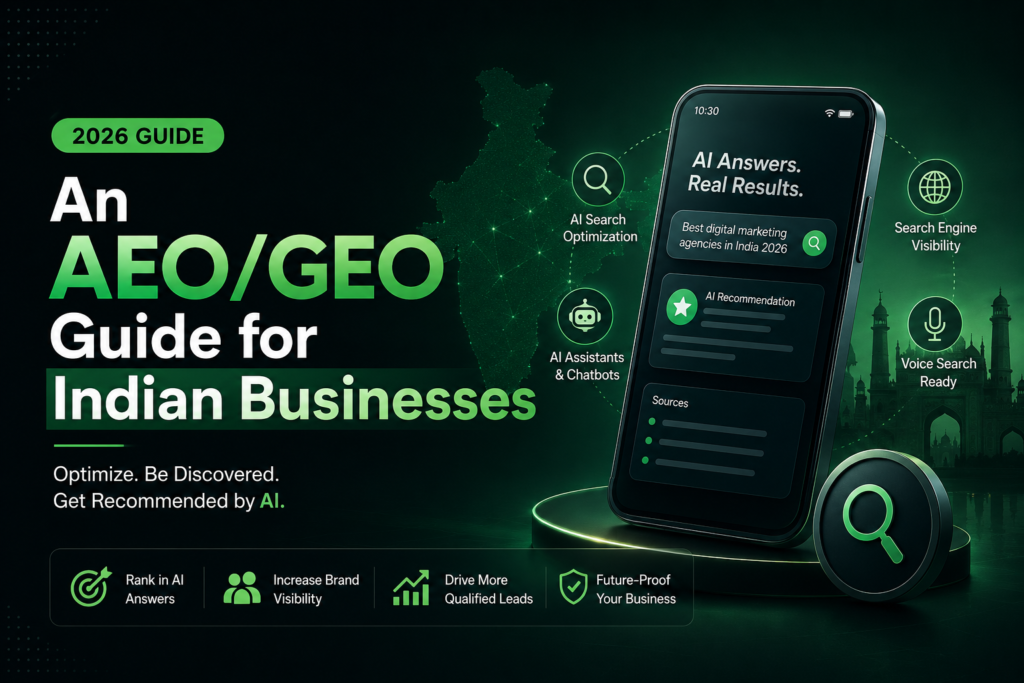
This is the shift practitioners are calling AEO (Answer Engine Optimization) and GEO (Generative Engine Optimization) — and for small and mid-sized Indian businesses, getting ahead of it now is one of the few remaining “first mover” opportunities in digital marketing. This guide is a practical checklist to help you get quoted inside AI answers, not just ranked in blue links.
- What AEO and GEO Actually Mean (And Why the Distinction Barely Matters)
- Why This Matters Right Now for Indian Businesses
- The AEO/GEO Checklist: 8 Steps to Get Cited
- 1.Answer the question in the first two sentences
- 2.Structure content the way AI systems parse it
- 3.Build a genuine FAQ section — and keep it honest
- 4.Show real experience — not just expertise
- 5.Implement the schema types that actually move the needle
- Keep NAP and entity data consistent everywhere
- 7.Refresh content and date it visibly
- 8.Track citations, not just rankings
- A Quick Worked Example
- Where AEO/GEO Fits Into Your Broader Strategy
- FAQ: AEO & GEO for Indian Businesses
What AEO and GEO Actually Mean (And Why the Distinction Barely Matters)
You’ll see AEO, GEO, AI SEO, and LLMO (large language model optimization) used almost interchangeably, and that’s not a mistake on anyone’s part — there’s genuinely no settled, universally agreed definition yet.
Roughly:
- AEO (Answer Engine Optimization) is about being extracted as a direct answer — think featured snippets, voice search, and the short synthesized box at the top of Google.
- GEO (Generative Engine Optimization) is the broader discipline of getting cited inside longer, conversational answers from tools like ChatGPT and Perplexity.
In practice, the same techniques serve both: clear direct answers, tight structure, fact density, FAQ sections, and verifiable accuracy. You don’t need to pick a lane — a well-built AEO strategy naturally supports GEO goals too.
What’s changed the game is volume. A large share of searches are now “zero-click” — the user gets their answer without visiting any website. If you rank #1 on Google but the AI Overview above your listing doesn’t cite you, a competitor who does get cited just took your customer before they ever saw the blue links.
Why This Matters Right Now for Indian Businesses
Three things are converging in 2026 that make this urgent rather than optional:
1. E-E-A-T has become the core filter for AI citation, not just a ranking nice-to-have. AI systems are trying to decide “can I trust this source enough to put its claim in my answer?” Experience, Expertise, Authoritativeness, and Trustworthiness are exactly the signals that answer that question — a generic, unattributed blog post rarely clears the bar, no matter how well it targets keywords.
2. Structured data is doing more work than before. A widely cited 2025 Search Engine Land experiment found that between two otherwise similar pages, only the one with well-implemented schema markup appeared in an AI Overview — the page without schema didn’t even get indexed for the query. Google has been explicit that schema isn’t a direct ranking factor, but it’s become a meaningful trust and clarity signal that helps AI systems verify who you are before citing you.
3. Indian brands that move early are already seeing results. Case studies from GEO-focused Indian agencies in 2026 show category-specific wins — D2C and local-service brands appearing in ChatGPT and Gemini responses for competitive product and service queries within weeks of implementing structured entity data and answer-first content. The window where this is still a differentiator, rather than table stakes, is closing.
The AEO/GEO Checklist: 8 Steps to Get Cited
1.Answer the question in the first two sentences
AI systems (and the crawlers that feed them) reward content that leads with the answer. If someone asks “What does a GST-registered freelancer need to invoice a client?”, your section on that topic should answer it in the opening lines — not build up to it after three paragraphs of context. Save the elaboration, examples, and nuance for after the direct answer.
2.Structure content the way AI systems parse it
When an AI engine processes a query, it typically breaks it into smaller sub-questions and searches for each separately — a process sometimes called “query fan-out.” Content that maps cleanly to likely sub-questions gets picked up more often. That means:
- One clear H2/H3 per sub-question
- Short paragraphs (2–4 sentences)
- Bulleted lists and numbered steps wherever a process is being described
- Tables for comparisons (pricing, features, timelines)
Research on real-world AI answer citations has found that pages using structured lists, direct quotes from credible sources, and specific statistics see meaningfully higher visibility in AI-generated responses than plain narrative prose.
3.Build a genuine FAQ section — and keep it honest
FAQ sections remain one of the highest-leverage formats for AEO, because they mirror how people actually phrase questions to AI tools. But there’s a catch: search platforms tightened how liberally they display FAQ and How-To rich results after abuse became widespread, so treat FAQ schema conservatively and only mark up FAQs that are genuinely answering real user questions on that page — not a bolted-on block for SEO padding.
Aim for:
- Long-tail, natural-language questions (“How much does Google Ads cost for a small business in Mumbai?” rather than “Google Ads cost”)
- 2–4 sentence direct answers
- India-specific figures, currency (₹), and context where relevant
4.Show real experience — not just expertise
This is the “E” that’s easiest to fake and easiest for AI systems (and readers) to spot as hollow. Concretely, this means:
- Named authors with real credentials, not “Admin” or “Team”
- First-hand specifics: client scenarios (anonymized if needed), screenshots of your own dashboards, numbers from campaigns you’ve actually run
- Original data or observations, not just a rewrite of five other blog posts on the same topic
- Author bio pages with schema markup connecting the person to your Organization entity
Generic, interchangeable content is exactly what AI systems are trying to filter out when choosing what to cite — thin or templated content won’t be rescued by good technical SEO underneath it.
5.Implement the schema types that actually move the needle
You don’t need every schema type on Schema.org. For most Indian SMBs, five types cover almost everything that matters for AI visibility:
| Schema Type | What It Does | Where to Use It |
|---|---|---|
| Organization | Establishes your business as a verifiable entity — the anchor for everything else | Every page, ideally one global graph |
| LocalBusiness | Confirms location, hours, service area for local queries | Homepage, contact page, location pages |
| Article / BlogPosting | Marks blog content with author, publish date, modified date | Every blog post |
| FAQPage | Marks genuine Q&A content for extraction | Pages with real FAQ sections only |
| Person | Connects named authors to their credentials and other work | Author bio pages |
Use JSON-LD format (Google’s recommended method), keep a stable @id for your Organization, and reference it consistently across other schema blocks rather than creating disconnected entities on every page.
Keep NAP and entity data consistent everywhere
AI systems cross-reference your website against other data sources — directories, social profiles, review platforms — before deciding whether to trust and cite you. If your business Name, Address, and Phone number differ even slightly between your website, Google Business Profile, Justdial listing, and Instagram bio, that inconsistency is a trust signal working against you. Audit and align these before investing further in content.
7.Refresh content and date it visibly
AI retrieval systems weight recency heavily for anything time-sensitive — pricing, platform features, regulations, statistics. A simple “Last updated: [month, year]” line, combined with genuinely refreshed statistics and examples, signals freshness to both AI systems and human readers. Set a quarterly reminder to revisit your highest-value pages rather than treating them as one-and-done.
8.Track citations, not just rankings
Traditional rank tracking won’t tell you whether ChatGPT or AI Overviews are quoting you. Build a lightweight monitoring habit:
- Periodically ask ChatGPT, Gemini, and Perplexity the exact questions your target customers would ask, and check whether your business appears
- Watch Google Search Console for AI Overview appearances (Google has started surfacing some of this data)
- Track branded search volume — AI citations often drive people to search your business name directly afterward, even without a click from the AI answer itself
A Quick Worked Example
Say you run a home bakery in Thane and someone asks ChatGPT, “best custom cake bakeries near Thane for birthdays.” For your website to have a shot at being mentioned, the underlying content needs to combine several of the steps above: a page with LocalBusiness schema confirming your Thane location, an About or bio section establishing real experience (years baking, signature specialties, a genuine photo), consistent NAP details matching your Google Business Profile, and an FAQ block genuinely answering questions like “Do you deliver in Thane?” or “How far in advance should I order a custom cake?” No single element gets you cited — it’s the combination that builds enough trust for the AI system to quote you with confidence.
Where AEO/GEO Fits Into Your Broader Strategy
AEO and GEO aren’t a replacement for SEO — they’re an extension of the same discipline of demonstrating that you’re the credible, well-structured source of an answer, whether the reader is a human scanning blue links or an AI synthesizing a response. If you’re still deciding how to prioritize your channels and budget, our complete digital marketing guide for small businesses in India is a good starting point, and our breakdown of SEO vs. Google Ads can help you sequence organic and paid investment.
If you’d rather not audit your schema, entity consistency, and content structure alone, that’s exactly the kind of technical-plus-content work our SEO services team handles for clients across India — including AI visibility audits as part of the engagement.