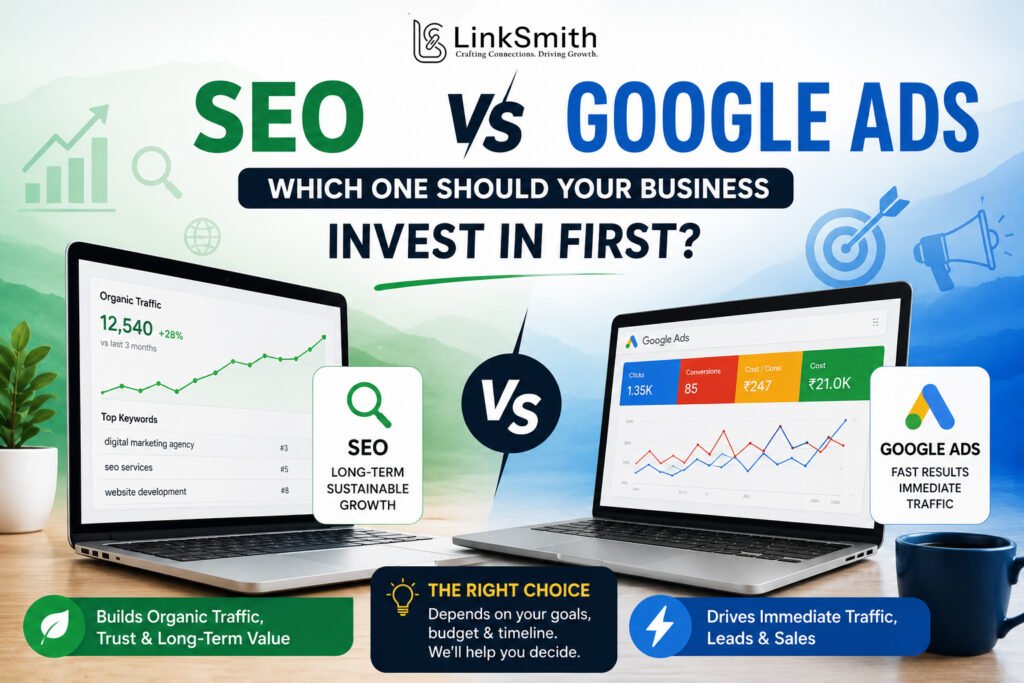
If you have a limited marketing budget and can only start with one channel, this is probably the most common question business owners ask an SEO services provider or a Google Ads agency: SEO or PPC — where do I put my money first?
There’s no universal answer, but there is a clear, data-backed way to decide based on your timeline, budget, and industry. This guide breaks down the real trade-offs so you can make that call with confidence.
- The Core Difference Between SEO and Google Ads
- Speed: How Fast Each Channel Actually Works
- Cost: What SEO and Google Ads Really Cost
- ROI: Which One Wins Over Time
- When You Should Start With Google Ads
- When You Should Start With SEO
- The Combined Strategy (What Most Businesses Get Wrong)
- A Simple 3-Question Decision Framework
- Frequently Asked Questions
The Core Difference Between SEO and Google Ads
Both channels put your business in front of people searching on Google — but they work in fundamentally different ways.
Google Ads (PPC) is rented visibility. You bid on keywords, pay per click, and appear at the top of search results immediately. The moment you stop paying, your traffic stops too.
SEO (Search Engine Optimisation) is owned visibility. You invest in your website’s content, structure, and authority so Google ranks you organically, without paying per click. It takes longer to build, but once you rank, that traffic keeps arriving without an ongoing per-click cost.
Neither is “better” in the abstract — they solve different problems on different timelines.
Speed: How Fast Each Channel Actually Works
This is where the two channels differ most sharply.
- Google Ads can put you on page one the same day you launch a campaign. If you need leads within 30-60 days, PPC is the only channel that can realistically deliver that.
- SEO typically takes 3-6 months to show initial ranking movement, and 6-12 months to deliver meaningful, compounding traffic. It’s a long-term asset, not a quick fix.
Winner for speed: Google Ads, decisively. But speed alone shouldn’t decide your budget — cost and long-term ROI matter just as much.
Cost: What SEO and Google Ads Really Cost
Google Ads / PPC:
- You pay for every click, and cost-per-click varies enormously by industry — from relatively cheap local search terms to very expensive categories like legal, insurance, and finance.
- Beyond ad spend itself, most businesses also pay a management fee to a Google Ads agency, typically a percentage of ad spend or a flat monthly retainer.
- Total realistic monthly investment for a small business running a properly managed campaign: often somewhere in the range of a modest local budget up to a much larger figure for competitive industries.
SEO Services:
- Costs are front-loaded — mostly content creation, technical fixes, and link-building — and don’t scale directly with every visitor the way PPC does.
- Once a page ranks, it continues generating traffic without an additional per-click cost, which is the core advantage over time.
The key cost insight: PPC cost-per-lead tends to stay flat or rise over time as competition increases. SEO cost-per-lead tends to fall over time as your content builds authority and rankings compound.
ROI: Which One Wins Over Time
Looking purely at return on investment over a longer horizon, SEO tends to pull ahead — but the crossover point matters.
- In the first year, PPC almost always shows a better return, because you’re generating leads immediately while SEO is still building.
- By year two or three, well-executed SEO typically wins on cost efficiency, sometimes dramatically, because the ongoing cost per lead keeps dropping while PPC’s stays roughly the same.
- The exact “crossover point” where SEO overtakes PPC on cost-per-visitor usually falls somewhere between month 6 and month 18, depending on how competitive your keywords are.
Put simply: PPC wins short-term ROI. SEO wins long-term ROI.
When You Should Start With Google Ads
Choose PPC first if:
- You need leads within the next 30-60 days (new business, seasonal push, cash flow pressure)
- You want to test which keywords, offers, and landing pages actually convert before investing in long-form SEO content around them
- Your industry has high-intent, “ready to buy” search terms where paid placement captures customers who’d otherwise go to a competitor
- You have budget to sustain the campaign consistently — pausing and restarting PPC repeatedly wastes the algorithm’s learning period
A useful side benefit: your Google Ads account generates real search-term data — showing exactly which keywords convert, at what cost, and how often — that becomes valuable input for your SEO strategy later.
When You Should Start With SEO
Choose SEO first if:
- You can wait 4-6 months for results and want to reduce long-term dependence on paid traffic
- Your industry has expensive cost-per-click rates, where organic rankings offer a much better long-term cost structure
- You’re a local service business — local SEO (Google Business Profile, reviews, location pages) is consistently one of the highest-ROI channels available, and it also makes any future PPC campaigns more efficient
- You want to build a durable asset rather than a rented one — SEO traffic doesn’t disappear the moment your budget runs out
The Combined Strategy (What Most Businesses Get Wrong)
The businesses that grow fastest in 2026 don’t pick one channel and ignore the other — they run both, deliberately, at different stages of the funnel. Research consistently shows businesses running coordinated SEO and PPC strategies achieve meaningfully higher overall ROI than those relying on either channel alone.
Here’s why the combination works so well:
- PPC captures demand right now — bottom-of-funnel searchers who are ready to buy today.
- SEO builds authority over time — top-of-funnel visibility that compounds and eventually reduces how much you need to spend on ads.
- Your PPC data improves your SEO strategy. Real conversion data from paid campaigns tells you exactly which keywords and landing pages are worth building organic content around.
- Your SEO authority can improve PPC efficiency. Google’s algorithms take your organic authority and local trust signals into account, which can lower your effective cost-per-click over time.
A common, practical allocation for businesses that can afford both: 60-70% of budget toward SEO for sustainable growth, 30-40% toward PPC for immediate visibility — then adjust based on which channel is actually converting best for you.
A Simple 3-Question Decision Framework
If you only have budget for one channel right now, ask yourself:
1. Do I need leads within the next 60 days? Yes → Start with Google Ads. No → You have room to invest in SEO first.
2. Is my industry’s cost-per-click very high (legal, insurance, finance, real estate)? Yes → Prioritise SEO to avoid a rising ad-spend dependency. No → PPC costs are more manageable; either channel works.
3. Am I a local business relying on nearby customers? Yes → Local SEO should be a priority regardless of what else you do — it’s typically the highest-ROI channel available and makes every other channel work harder too. No → Weigh speed vs. long-term cost using questions 1 and 2.
If you’re still unsure after these three questions, the safest default for most small businesses is: start SEO now (it takes months to show results, so the earlier you start, the better) and run a lean, well-tracked PPC campaign in parallel for immediate leads.
Frequently Asked Questions
Not sure which channel fits your specific business? The right starting point depends on your industry, budget, and how quickly you need results — use the 3-question framework above, or get in touch for a tailored recommendation.
Leave a Reply