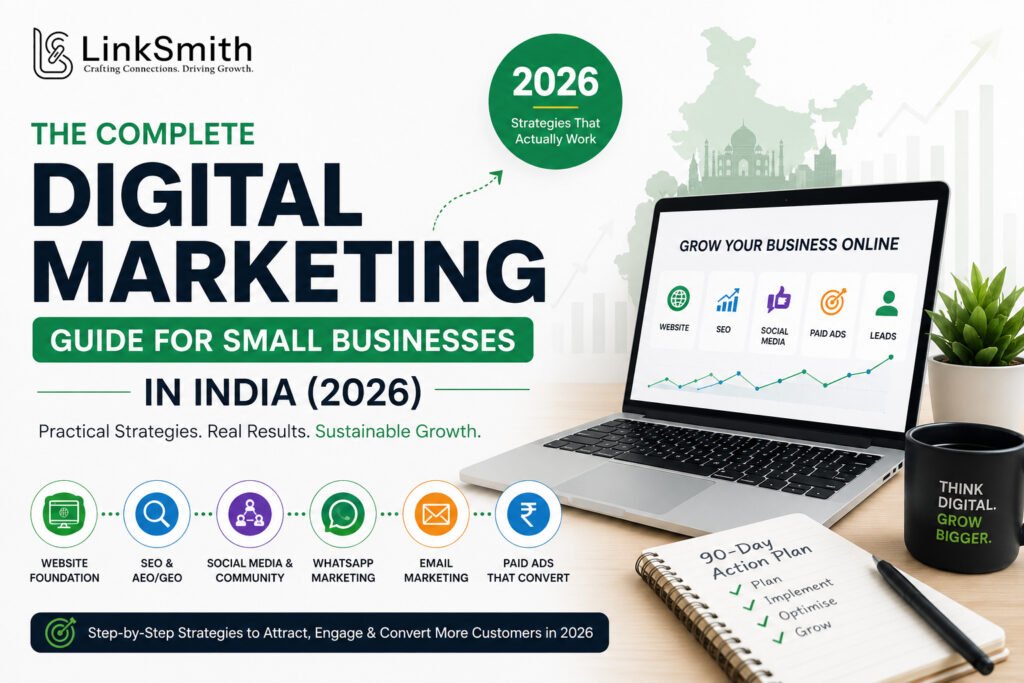
If you run a small business in India, you already know the problem: you’re not competing with two shops down the road anymore. You’re competing with every business selling something similar, anywhere in the country, all fighting for the same phone screen. India crossed the 900-million internet user mark in 2026, and the businesses winning right now aren’t necessarily the ones with the biggest budgets — they’re the ones using the right channels, consistently, in the right order.
This guide breaks down exactly what to do, in what order, and roughly what it costs — without the jargon.
- Why Digital Marketing Is No Longer Optional in 2026
- Step 1: Get Your Website Right (Your Most Important Asset)
- Step 2: SEO — Getting Found on Google (For Free)
- Step 3: The New Layer — AEO and GEO (Optimising for AI Search)
- Step 4: Local SEO — Winning the "Near Me" Search
- Step 5: Social Media Marketing
- Step 6: WhatsApp Marketing
- Step 7: Email Marketing
- Step 8: Paid Advertising (Google Ads & Meta Ads)
- Step 9: AI Tools Every Small Business Should Use in 2026
- Realistic Digital Marketing Budgets for Indian Small Businesses (2026)
- A Simple 90-Day Action Plan
- Frequently Asked Questions
Why Digital Marketing Is No Longer Optional in 2026
A decade ago, a small business could survive on referrals, a signboard, and word of mouth. That’s no longer realistic. Most customers — from metro cities to Tier 2 towns like Nashik, Coimbatore, and Bhopal — now discover, research, and judge a business online before ever calling or walking in.
Three shifts make 2026 different from even two years ago:
- AI is now infrastructure, not a novelty. Google’s AI Overviews, ChatGPT, and Perplexity are answering questions that used to send people to a list of blue links. Being findable by these tools matters as much as ranking on page one.
- India’s digital ad market is expanding fast, with digital ad spend pushing well past ₹75,000 crore, meaning more businesses are competing for the same attention.
- WhatsApp has become a full sales channel, not just a support tool — Indian buyers now complete entire purchase journeys inside chat and social apps.
The businesses that grow steadily in 2026 are the ones building an integrated system across a few channels, not chasing every new platform.
Step 1: Get Your Website Right (Your Most Important Asset)
Before spending a rupee on ads, your website needs to do three things:
- Load fast on mobile. Most Indian traffic is on a phone, often on 4G. A page that takes more than 3 seconds to load loses visitors before they even see your offer.
- State clearly what you do, for whom, and how to contact you — visible in the first screen, no scrolling required.
- Have one obvious next step — a “Call Now,” “WhatsApp Us,” or “Get a Quote” button that’s impossible to miss.
If you don’t have a website yet, a simple 4-5 page site (Home, About, Services, Contact, Blog) is enough to start. Don’t wait for a “perfect” 20-page site before you begin marketing.
Step 2: SEO — Getting Found on Google (For Free)
SEO (Search Engine Optimisation) is still the foundation of everything else in 2026. Even with AI search growing, traditional organic search results still account for the large majority of clicks in India, especially for local services, e-commerce, and B2B buyers doing serious research.
What actually moves the needle for a small business in 2026:
- Target long-tail, conversational keywords, not just short generic ones. Instead of writing only for “best bakery Mumbai,” also write for “which bakery delivers birthday cakes same day in Mumbai.”
- Answer the question in the first 2-3 sentences of every page or blog post, then go deeper below. This single habit helps you rank in both classic search and AI-generated answers.
- Fix technical basics: mobile usability, page speed, HTTPS, and a clean site structure. AI systems and Google both need to be able to crawl your site before they can rank or cite it.
- Build genuine topical depth. A cluster of five focused pages on related topics tends to outperform one long “everything” page.
- Earn a few real backlinks from local directories, industry associations, and press mentions rather than chasing hundreds of low-quality links.
Step 3: The New Layer — AEO and GEO (Optimising for AI Search)
This is the biggest shift for 2026, and most small businesses haven’t caught up yet — which is exactly why it’s an opportunity.
- AEO (Answer Engine Optimisation) is about structuring your content so Google’s featured snippets, “People Also Ask” boxes, and AI Overviews can lift your answer directly.
- GEO (Generative Engine Optimisation) is about becoming the source that AI chatbots like ChatGPT, Perplexity, and Gemini actually cite or recommend when someone asks a question in your category.
Google itself has confirmed there isn’t really a separate “AI search strategy” — AEO and GEO are extensions of good SEO, not a replacement for it. In practice, that means:
- Use a question as your H2 or H3 heading, then answer it plainly in 40-60 words directly underneath — that snippet-sized block is what gets lifted into AI answers.
- Add FAQ, Article, LocalBusiness, and Review schema markup so AI systems can read your page’s structure, not just its text.
- Include specific numbers, dates, and named facts (AI systems favour content that reads like verifiable evidence, not vague marketing copy).
- Keep business information — name, address, phone number, services — identical across your website, Google Business Profile, and social pages. AI tools cross-check consistency before trusting a source.
A useful way to think about it: one well-built page — with clear headings, a direct answer near the top, and schema markup — can rank in Google’s blue links, get picked up by AI Overviews, and get cited by ChatGPT, all at the same time.
Step 4: Local SEO — Winning the “Near Me” Search
If you serve a physical area — a shop, clinic, salon, restaurant, or service business — local SEO is often the single highest-ROI channel available to you.
- Claim and fully complete your Google Business Profile: accurate category, service area, photos, opening hours, and a WhatsApp/phone number.
- Collect reviews consistently. Ask every satisfied customer directly; a steady stream of recent reviews matters more than a one-time push for 100 reviews.
- Get listed on local directories relevant to your city or industry (Justdial, Sulekha, industry-specific listings).
- Post updates on your Google Business Profile regularly — offers, new products, events — since Google rewards profiles that stay active.
Step 5: Social Media Marketing
Social media in 2026 is where trust gets built and, increasingly, where sales happen directly.
- Short-form video is dominant. Instagram Reels, YouTube Shorts, and Facebook Reels are where most discovery now happens — especially for products, food, fashion, and services with a visual element.
- Social commerce is a real revenue channel now. Instagram, YouTube, and WhatsApp all support in-app purchase flows, so treat your social profiles as storefronts, not just billboards.
- Vernacular content performs strongly. Content in Hindi, Tamil, Gujarati, and other regional languages is no longer a “nice to have” for businesses targeting Tier 2/3 cities — it often outperforms English content in engagement.
- Pick 1-2 platforms and be consistent, rather than spreading thin across five. For most small businesses: Instagram + WhatsApp, or Instagram + YouTube, is a strong starting combination.
Step 6: WhatsApp Marketing
WhatsApp deserves its own section because of how central it’s become to Indian commerce.
- With over 500 million Indian users, WhatsApp is often the first and last touchpoint before a sale.
- WhatsApp Business API costs have dropped significantly, making automated order confirmations, appointment reminders, and follow-ups affordable even for very small budgets.
- Engagement on WhatsApp messages tends to run far higher than email open rates, making it one of the best channels for nurturing warm leads.
- Set up a simple WhatsApp catalogue, an auto-reply for common questions, and a basic chatbot flow for order status or booking — most of this can be done without a developer using WhatsApp Business App or affordable third-party tools.
Step 7: Email Marketing
Email isn’t the flashiest channel, but it’s the one you fully own — no algorithm can take it away from you.
- Use email to nurture leads who aren’t ready to buy yet: a simple 3-5 email welcome sequence after someone signs up builds trust before you ask for the sale.
- Segment your list by interest or purchase stage rather than emailing everyone the same message.
- Keep subject lines short, specific, and honest — avoid clickbait, since Indian inboxes are increasingly filtered by spam algorithms that penalise it.
- Pair email with WhatsApp: use email for detailed content (newsletters, guides) and WhatsApp for time-sensitive nudges.
Step 8: Paid Advertising (Google Ads & Meta Ads)
Once your organic foundation (website, SEO, Google Business Profile) is in place, paid ads accelerate results rather than replace the groundwork.
- Google Ads works best for capturing people who are already searching with buying intent — ideal for services, local businesses, and anything with clear “ready to buy” keywords.
- Meta Ads (Facebook/Instagram) work best for building awareness and retargeting people who’ve visited your site or engaged with your content but haven’t converted yet.
- AI-driven campaign types — Google’s Performance Max and Meta’s Advantage+ — now handle much of the bidding and placement automatically, which lowers the skill barrier for small advertisers, but still need a clear budget cap and clean tracking to avoid overspending.
- Start small: a ₹300-500/day test budget over 2 weeks tells you more than guessing at a big campaign upfront.
- Always set up conversion tracking (calls, form fills, WhatsApp clicks) before you spend — without it, you’re flying blind.
Step 9: AI Tools Every Small Business Should Use in 2026
Affordable AI automation is the single biggest equalizer for small businesses this year — tools that used to be exclusive to large companies are now available for a fraction of the cost.
| Use Case | What It Does |
|---|---|
| WhatsApp/website chatbot | Answers common questions instantly, 24/7 |
| AI writing assistants | Drafts social captions, ad copy, and blog outlines faster |
| AI-powered CRM | Tracks leads automatically and flags follow-ups you’d otherwise miss |
| Auto-scheduling tools | Queues a month of social posts in one sitting |
| AI image/video tools | Produces basic product visuals and reels without a design team |
Use these tools to save time on repetitive work — but keep a human reviewing anything that represents your brand voice or makes claims to customers.
Realistic Digital Marketing Budgets for Indian Small Businesses (2026)
There’s no single right number — it depends on your city, competition, and goals — but here’s a realistic starting range:
- Starter (₹15,000 – ₹25,000/month): SEO + social media management, focused on organic growth, minimal or no paid ads.
- Growth (₹25,000 – ₹50,000/month): SEO + social media + a modest paid ads budget + basic WhatsApp automation.
- Scale (₹50,000+/month): Full-funnel approach — SEO, paid ads across platforms, email/WhatsApp automation, and content production.
Businesses using three or more digital channels together tend to see substantially higher conversion rates than those relying on a single channel — the channels reinforce each other rather than compete for the same budget.
A Simple 90-Day Action Plan
Days 1-30: Foundation
- Finalise/fix your website and Google Business Profile
- Set up WhatsApp Business with a catalogue and auto-replies
- Identify 10-15 target keywords (mix of short and long-tail) 1
- Publish 2-4 SEO-optimised blog posts answering real customer questions
Days 31-60: Visibility
- Post consistently on 1-2 social platforms (aim for 3-4 posts/week)
- Start collecting Google reviews actively
- Launch a small test Google Ads or Meta Ads campaign
- Set up a basic email welcome sequence
Days 61-90: Optimise
- Review what’s working using Google Search Console and ad platform data
- Double down on the channel bringing the best-quality leads
- Add schema markup and tighten your top-performing pages for AEO/GEO
- Build your first WhatsApp broadcast list from engaged customers
Frequently Asked Questions
Have questions about where to start with your specific business? The right combination of channels depends on your industry, city, and budget — start with the 90-day plan above and adjust based on what brings you real leads.
Leave a Reply